

Satya B. Chaparala, MD – Medical Director
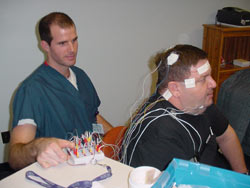 A sleep technologist demonstrates a ‘set up’ on a patient in preparation of a sleep study at Battle Creek Health System’s recently expanded Sleep Center. |
Some sleep disorders are potentially life threatening, but the majority, some 95% go undiagnosed and untreated. As a sleep-deprived society that views sleep as optional, we need to change our attitudes about sleep. Our bodies depend upon it.
Statistics underscore that message:
- 10% of the general population have chronic insomnia
- 1 in 5 drivers admits to falling asleep while driving
- 1 in 3 pilots admits to falling asleep while flying
- 25% of adult males in the U.S. have episodes of sleep apnea
- 25 to 40% of children diagnosed with ADD/ADHD have some form of sleep disorder
Sleep physicians believe that their patients’ sleep habits materialize as symptoms while they are awake. With inadequate sleep, a person may become fatigued and drowsy. A patient, for example, may complain about lack of ‘pep.’ Two questions could point the way to diagnosing the problem. ‘Is the patient getting enough sleep?’ and ‘Is she or he waking up well rested?’
There are also visual clues that may indicate patients at risk. If you have a thick, short neck or are obese, you could be sleep deprived.
One of the most common of diagnoses is obstructive sleep apnea syndrome (OSAS). That is where a patient may stop breathing anywhere from a dozen to hundreds of times each night. Often, the person suffering from sleep apnea may not be aware of what is happening while they sleep, but their bed partner is if their partner snores loudly or thrashes around at night.
Sleep can be considered a ‘change of shifts.’ There is the ‘awake’ day brain and the ‘sleeping’ night brain. The transition or ‘shift change’ from wakefulness to sleep normally takes approximately 10 to 20 minutes. The body needs time to properly shut down the ‘awake’ brain and activate the sleep cycles. Sleep doesn’t just happen. It is an active process, something that we all must do. It is necessary work for a healthy human body.
Many patients with sleep disorders are in the 35 to 50 year-old age range and tend to rationalize their symptoms. They believe fatigue is just part of growing older. Others think they are tired all the time because they are working too hard. Sleep issues are persistently ignored; patients often wait years to seek help. Sleep studies can help identify the problem early.
Some patients referred for a sleep study are apprehensive of the idea of spending an entire night away from home, hooked up to monitoring equipment. However, it is important for them to understand that the data from an average eight-hour test is usually needed to check for any breathing problems or limb movements during the different stages of sleep. There is no typical one-hour of sleep– patients should be observed during an entire sleep period.
Children are not usually seen as having the potential for sleep disorders, except for the occasional snoring or night terrors. However, recent studies by the American Academy of Sleep Medicine have found that a number of children may have been misdiagnosed with ADHD when they actually have OSAS.
That is due to daytime symptoms common in both disorders, including behavioral problems, difficulty in concentrating, and hyperactivity. Some sleep specialists believe that any child diagnosed with ADD or ADHD should be evaluated for potential sleep disorders before they are put on medication.
Sleep studies are available locally
Trained technologists keep watch while patients undergo sleep studies at the Battle Creek Health System Sleep Center. The staff includes the medical director, a nurse practitioner, registered polysomnographic sleep technologists, respiratory therapists, and EEG technologists.
Richard Craig, RPSGT, oversees the teams who ‘crunch the numbers’ from a computerized sleep study. They determine what stage of sleep the patient is in and track how many times they experience apneas or engage in periodic limb movement. That report is then given to sleep physicians to interpret. Since physicians refer patients to the center, those reports are then sent back to them to arrange for treatment. The BCHS Sleep Center offers the full continuum of care.
“When a patient is referred to the sleep clinic by their physician, we get a detailed history and ask sleep-related questions,” Craig said. “During that process, we can determine whether a sleep study is necessary. If a study shows strong evidence of sleep apnea, we can provide immediate treatment alternatives.”
The actual sleep study is performed over a normal eight-hour sleep period. EEG and ECG monitors including one- or two-dozen sensors that record limb movements, muscle activity, and breathing patterns are attached by tape to the patient. The tests are noninvasive–there are no drugs or needles used, nothing goes under the skin.
To meet the growing demand for studies over the past decade, the BCHS Sleep Center has expanded from its original one-bed unit to eight beds. The center has large, comfortable rooms similar to hotel accommodations with full and queen-size beds and private bathroom and shower facilities. It offers flexible day and night hours to conduct sleep studies that fit into the patients’ regular sleep time schedules. Pediatric sleep testing and services are also available. For detailed information about the Battle Creek Health System Sleep Center, located in the Fieldstone Center in Battle Creek, call (269) 964-5347.